Bouaké: 10 billion CFA franc shea factory opens, yet 60% of Ivorian kernels are still exported raw
A shea and soy processing unit, Beta Veg Oil, was inaugurated on Monday, October 12, 2026, in Kongodékro, in the commune of Bouaké, in central Côte d'Ivoire. Its promoters, Mounir Fakry and Pierre Ali, present it as the largest solvent extraction facility in the country, with an announced capacity of 70,000 tonnes of raw materials per year, according to the Ivorian Press Agency (AIP).
The investment amounts to 10 billion CFA francs, or approximately 17 million dollars, for a project launched in January 2025, reports Agence Ecofin. The shea butter line is already operational; refined soy oil and animal feed meal are to follow. The factory announces 450 direct jobs, in addition to 250 day laborers already mobilized, and a second phase of expansion planned for December, according to KOACI.
"Women's gold"
The ceremony was presided over by Amadou Koné, Minister of Transport and Mayor of Bouaké, alongside Bruno Nabagné Koné, Minister of Agriculture, and Ibrahim Kalil Konaté, Minister of Trade and Industry. The Minister of Agriculture advocated for making shea "truly the gold of women," by calling for better remuneration for producers, according to KOACI.
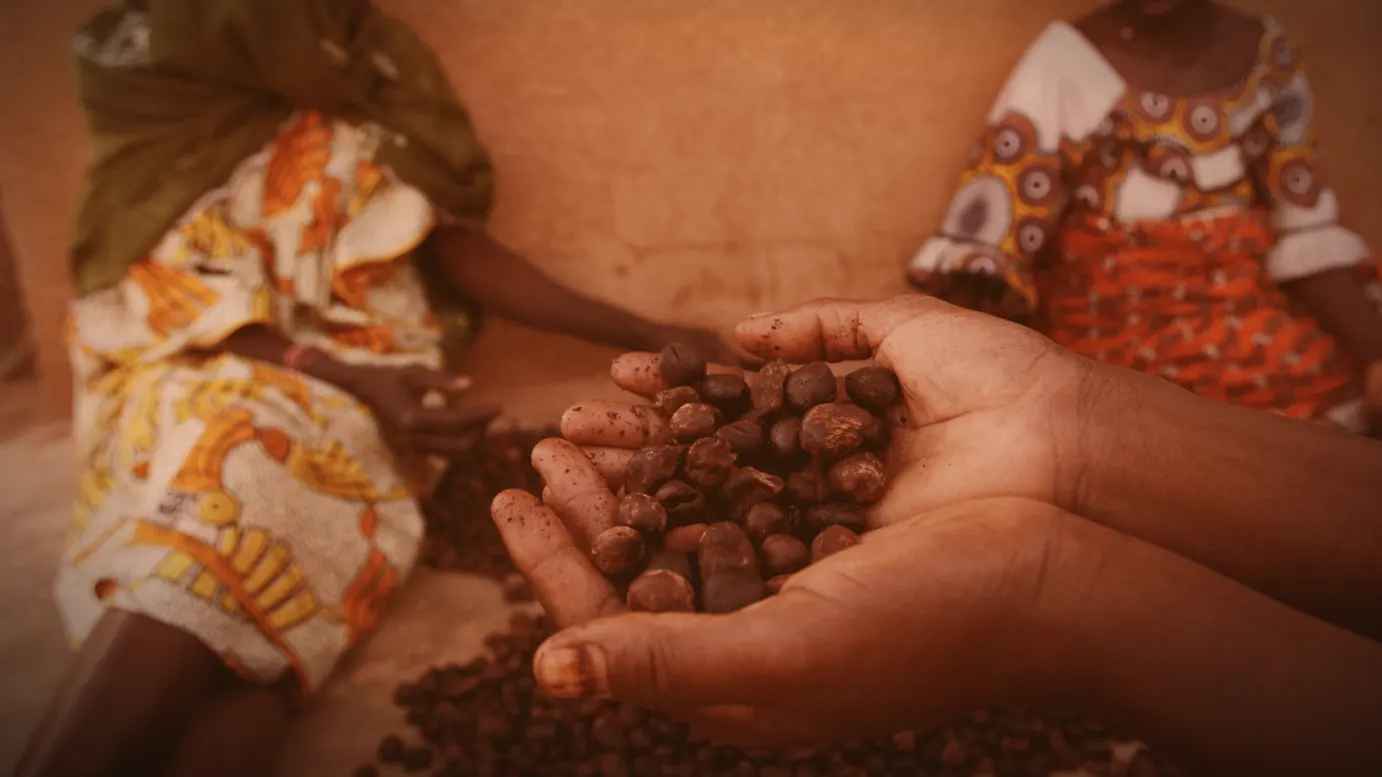
Ivorian shea relies on the collection of kernels by women in rural areas: approximately 400,000 collectors could find an outlet with this factory, according to the AIP. A program dubbed Beta Nafa provides for 20% of purchases to be made directly from collectors, without intermediaries and at announced stable prices, with the training of groups and the pre-financing of campaigns. Support for 30,000 women in eight production zones was announced, for a budget covering 5,000 tonnes of raw materials at 270,000 CFA francs per tonne, or 1.35 billion CFA francs, again according to KOACI.
Underutilized installed capacity
The gap remains between the announcements and the material actually processed on-site. During the ceremony, it was recalled that local cocoa processing has increased from 5 to 10% in 2011 to 46% today, and cashew processing to 43%, but that more than 60% of Ivorian shea production still goes abroad in the form of raw kernels, according to KOACI.
The country has about twenty processing units, with an installed capacity of approximately 130,000 tonnes of kernels per year, which is largely underutilized, according to the Cotton, Cashew and Shea Council (CCAK) cited by Agence Ecofin. During the 2025/2026 season, only 51,697 tonnes of kernels entered the formal circuit, all directed toward local factories, representing about 40% of this capacity. The target set for 2026/2027 is 60,000 tonnes. At the same time, 14,078 tonnes of shea butter were exported to thirteen countries in Asia, Europe, and America.
Abidjan has banned the land export of shea nuts and kernels since January 2025, and the CCAK has reserved purchases from collectors exclusively for processing units. Its chairman of the board, Jérôme Ehui, justified these measures by the need to better control supply chains and supply the local industry, according to Agence Ecofin. The municipal program "Bouaké Nouveau" aims to locally process 50% of regional agricultural production and create more than 10,000 direct industrial jobs by 2030. It is the volume of kernels actually collected and paid to women that will determine whether shea finally becomes a source of income, and not just an industrial capacity.
This article was written in French with the help of artificial intelligence from the sources cited below, then translated from French automatically. Read the original.