November 25, 1965: Mobutu takes power and promises to return it in five years
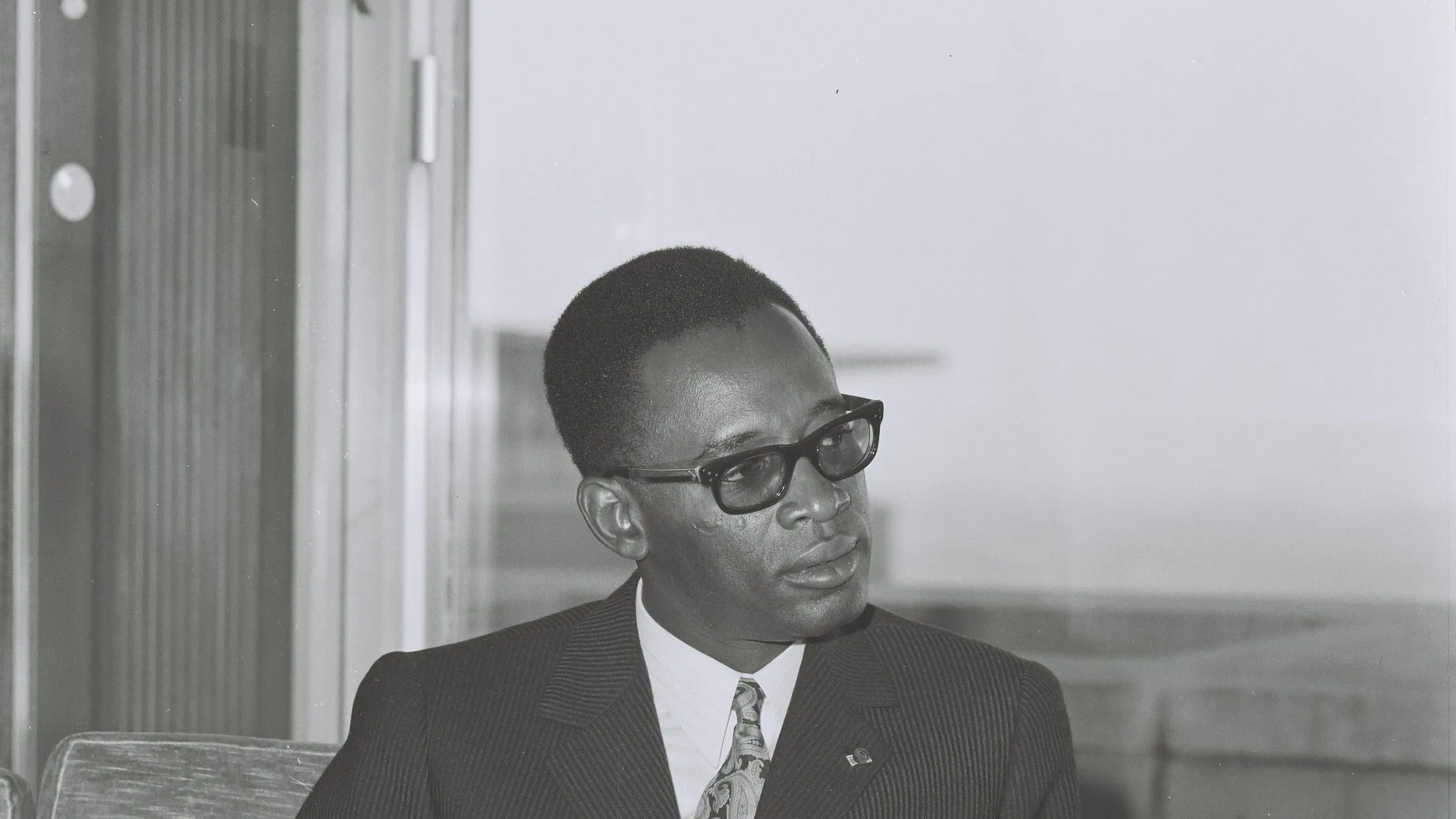
On the night of November 24 to 25, 1965, in Léopoldville — present-day Kinshasa —, General Joseph Mobutu, head of the Congolese army, announces on the radio that he is assuming all presidential powers. President Joseph Kasa-Vubu and his Prime Minister Évariste Kimba are ousted. Mobutu swears to keep these powers for only five years. He would keep them for thirty-two.
A deadlocked Parliament, an army taking charge
The Congo, independent for five years, is at a standstill. On October 13, 1965, Kasa-Vubu replaces Prime Minister Moïse Tshombe with Évariste Kimba. On November 14, Parliament denies him confidence by 76 votes to 72 in the Chamber and 58 to 49 in the Senate. The next day, Kasa-Vubu reappoints him anyway.
It is during this deadlock that the military steps in. According to the encyclopedic entry on the putsch, military leaders meet on November 24 and decide to overthrow the regime; the statement is read on the radio on the 25th. Encyclopædia Britannica dates the coup to the 24th. The operation results in no casualties.
A foreign hand is never far away: according to Le Monde, cited by the same entry, the trigger was the refusal of Minister of the Interior Victor Nendaka to entrust army commands to Belgian officers. Four years after the assassination of Lumumba, who commanded the Congo's weapons remained an open question.
The five years that lasted thirty-two
His eleven-point proclamation promises to preserve institutions, including Parliament. In reality, the March 1966 elections are canceled, the post of prime minister is abolished, and Parliament is stripped of its powers. The MPR becomes the sole ruling party from 1970 to 1990 and the country is renamed Zaire in 1971, in the name of "authenticity".
Léopoldville, June 2, 1966
The worth of the promise can be measured seven months later. In May 1966, Kimba and three former ministers — Jérôme Anany, Emmanuel Bamba, and Alexandre Mahamba — are arrested and tortured, accused of plotting to assassinate Mobutu. On May 30, a military tribunal tries them in an hour and a half, without a lawyer, and sentences them to death after seven minutes of deliberation — a sentence that, notes the entry dedicated to Kimba, violated Congolese law. On June 2, 1966, they are publicly hanged. Kimba was the second former Congolese prime minister killed after Lumumba.
According to Britannica, Mobutu later embezzled $400 million from Gécamines, the state mining company, and granted military units "the right to pillage" entire regions. On May 17, 1997, the forces of Laurent-Désiré Kabila entered Kinshasa; Mobutu had fled.
Key takeaway
On November 24 and 25, 1965, a general promised five years of emergency rule to end a parliamentary crisis, and confiscated thirty-two years of Congolese sovereignty. The briefest state of emergency on paper can become the longest in a country's history.
This article was written in French with the help of artificial intelligence from the sources cited below, then translated from French automatically. Read the original.