Koshari, Egypt's national dish: A story of many hands, and its recipe
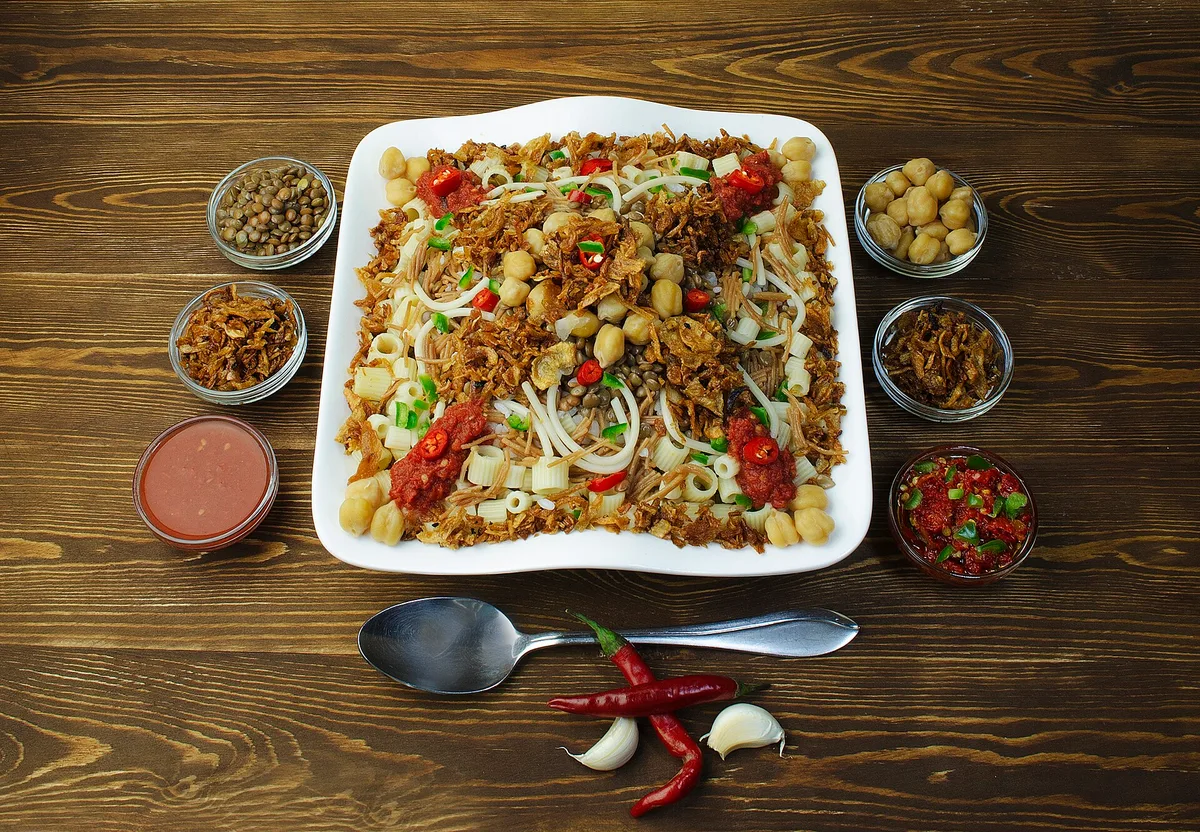
In Cairo, you eat it on the street, in restaurants, or at home. Rice, lentils, pasta, chickpeas, spicy tomato sauce, garlic vinegar, and fried onions: Koshari is Egypt's national dish. In December 2025, UNESCO even inscribed it on the Representative List of the Intangible Cultural Heritage of Humanity. Yet, its origin remains a mystery.
A pharaonic legend without proof
It is sometimes written that Koshari descends from "koshir," a dish of lentils, wheat, chickpeas, garlic, and onions that was supposedly served in ancient Egypt during religious rites, and that this account dates back to the Egyptian historian Manetho. However, as Wikipedia points out, there is no mention of "koshir" in the collected writings of Manetho. A beautiful story, then, but without proof.
1853: The first written record
The oldest known mention in English comes from the British explorer Richard Burton. In 1853, he described the breakfast of the inhabitants of Suez: a dish of Egyptian lentils, rice, butter, onions, and preserved lemons. Koshari was first sold from street carts before entering restaurants.
The Indian hypothesis
For most researchers, the very name of the dish comes from India: "Koshari" is thought to be a corruption of "khichri," an Indian dish of rice and lentils cooked in a single pot. According to this hypothesis, reported by Religion News Service, the dish arrived with Indian soldiers between the beginning of the British occupation of Egypt in 1882 and the end of the First World War. The media outlet Egyptian Streets also links it to khichri.
Pasta and communities from elsewhere
Macaroni and tomato sauce suggest other influences. Italians were very numerous in Egypt: on the eve of the Second World War, only the Greeks formed a larger immigrant community. Another popular belief, reported by Religion News Service, attributes the dish to the Jews of Egypt, linking "Koshari" to the word "kosher." Experts do not draw a definitive conclusion: these accounts are not necessarily mutually exclusive.
An Egyptian recipe
Regardless of its origin, it was the Egyptians who gave Koshari its current form by adding fried onions, chickpeas, cumin, paprika, and vinegar, explains Egyptian Streets. In Alexandria, it takes on a different character: yellow lentils, rice with curry and cumin, hard-boiled eggs browned in butter, and lightly marinated tomatoes.
A dish for all people
Nicknamed "the poor man's dish," Koshari is inexpensive, filling, and, when prepared with vegetable oil, contains no animal products. It is very popular among workers. According to UNESCO, it is prepared at home, served in restaurants, and sold from street carts, particularly near schools and in bustling neighborhoods. It is shared among neighbors and friends during family gatherings and national holidays. The skills are passed down primarily within families, from mothers to daughters.
In December 2025, during its meeting in New Delhi (from December 8 to 12), the UNESCO committee inscribed "Koshari, an everyday dish, and its associated practices" on the Representative List of the Intangible Cultural Heritage of Humanity.
The Koshari recipe
This recipe, for 6 to 8 people, is the one published by Egyptian Streets in 2021, based on the book "Minnie's Taste of Mediterranean Delight." The quantities have been converted into metric measurements (rounded).
Ingredients: 400g medium-grain white rice; 200g green lentils; 100g small pasta (ditalini, preferably); 1 can of chickpeas; 2 onions sliced into rings, a little flour, and oil for frying; 6cl oil; salt, pepper, and cumin; 75cl water.
For the sauce: 2 finely chopped onions; 1 diced green bell pepper; 6 minced garlic cloves; 4 large diced tomatoes; 2.5 tablespoons tomato paste; 12cl vinegar; 25cl water; 1 tablespoon oil; salt, pepper, paprika, and cumin.
1. Put all the sauce ingredients in a saucepan and let cook for 15 minutes over low heat. 2. Rinse the lentils and boil them for 5 minutes in 75cl of water with half a teaspoon of cumin, then drain and rinse with cold water. 3. Flour the onions and fry them until they are well browned; drain on paper towels. 4. Cook the pasta and drain.
5. In a large saucepan, add the oil, lentils, rinsed rice, salt, pepper, and cumin. Add 75cl of boiling water, let boil for 2 minutes, then cover and simmer for 15 minutes over low heat. 6. Sauté the drained chickpeas for 1 minute over high heat with a little butter, salt, pepper, and paprika. 7. Arrange the rice and lentils in a large dish, then top with the pasta and chickpeas. 8. Garnish with fried onions and paprika, and serve hot with a drizzle of sauce, with the rest of the sauce on the side.
Our perspective
Koshari tells the story of an Africa open to the world: a dish perhaps born in India, enriched by communities from elsewhere, and which has become, over time, the symbol of an entire nation. An identity is not always built by closing oneself off; it is also built by welcoming others.
This article was written in French with the help of artificial intelligence from the sources cited below, then translated from French automatically. Read the original.
Sources
- UNESCO : décision 20.COM 7.B.16, le koshari, plat du quotidien, et ses pratiques (2025)
- Egyptian Streets : The History of Koshari Is As Rich As Its Flavor (Mona Bassel, 2021)
- Egyptian Streets : Koshary, Egypt's Culinary Treasure Recognized by UNESCO (2025)
- Religion News Service : From hajj to Italian Jews, Egypt's national dish has a mixed heritage (2021)
- Wikipédia (anglais) : Koshary