November 17, 1869: The Suez Canal opens, dug by hand by Egyptian peasants
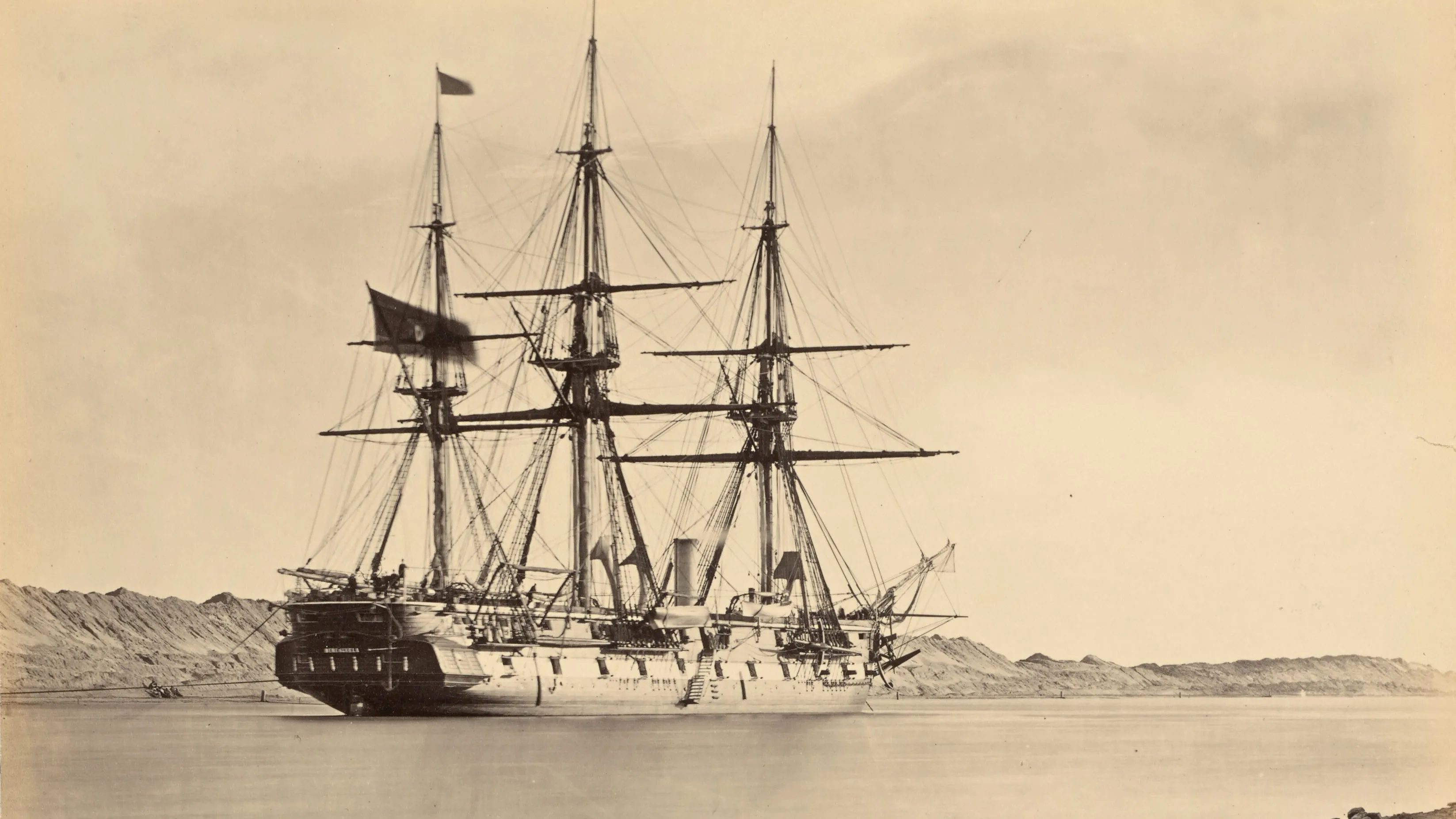
On November 17, 1869, the Suez Canal was officially opened to navigation. The festivities had begun in Port Said on the evening of November 15 with a banquet aboard Khedive Ismail Pasha's yacht, and on the 17th, a procession of ships entered the canal behind L'Aigle, the imperial yacht carrying Empress Eugénie. According to historian Caroline Piquet (Sorbonne, BnF's Bibliothèques d'Orient), it was "a global event" where France was the guest of honor. The men who had dug the structure do not appear on any guest list.
Ten years of construction, and forced labor
Excavation had begun on April 25, 1859, on the shore of the future Port Said. The Universal Suez Ship Canal Company, created on December 15, 1858, was to operate the structure for 99 years: Ferdinand de Lesseps had obtained his concessions from Said Pasha in 1854 and then in 1856. Ten years later, the canal measured 164 kilometers in length and 8 meters in depth, and some 74 million cubic meters of earth had been moved, according to the Encyclopædia Britannica.
Moved by whom? Until 1864, the construction site operated using the corvée, or forced labor, before the viceroy condemned the practice. Estimates cited by Wikipedia suggest more than 30,000 people were present at any given time and more than 1.5 million workers over the decade. The Egyptian media outlet Egyptian Streets, relying on historian Abdelaziz Al Shennawi and researcher Nathalie Montel, points out that most of the work was done by hand and that the workers sometimes "did not have enough to drink." In 1865, the cholera outbreak was so severe that there were not enough hands to transport the bodies.
How many deaths? Sources diverge
There is no consensus figure, and that in itself is a fact. In his speech on July 26, 1956, Gamal Abdel Nasser claimed 120,000 Egyptian deaths. A work by the Egyptian Ministry of Education published in 2014, cited by Egyptian Streets, estimates about 100,000 deaths out of one million Egyptians employed. Conversely, the Company's chief physician reported no more than 2.49 deaths per thousand in 1866, and Wikipedia considers the available data consistent with fewer than 3,000 deaths. The discrepancy is primarily explained by the lack of record-keeping: in the Company's archives, summarizes researcher Mohamed Gamal El-Din, "there is no trace of them."
The canal that slipped away from Egypt
The country did not just provide the labor. According to Caroline Piquet, Egypt paid for half the cost of the work, increasing its debt "worryingly." In 1875, Khedive Ismail, strangled by his creditors, had to sell the 44% stake he held in the Company to Great Britain. In 1882, the British occupied the country and proclaimed themselves guardians of the canal's security. The 1888 Convention of Constantinople finalized the transformation of this Egyptian trench into an international waterway.
It was not until the nationalization decided by Nasser on July 26, 1956, that the canal returned to the Egyptian state: eighty-seven years after its inauguration, and at the cost of the Suez Crisis of October-November 1956. Now 193 kilometers long, it saw more than 20,600 ships pass through in 2021, or 56 per day.
Key takeaways
The Suez Canal was not a gift to Egypt: dug by its peasants, half-funded by its Treasury, it was taken from the country through debt and then occupation. Its opening on November 17, 1869, is as much a technical feat as it is a textbook case of colonial spoliation.
This article was written in French with the help of artificial intelligence from the sources cited below, then translated from French automatically. Read the original.