"Before colonization, Africa had no large cities": false, here are seven cities that prove it
We often imagine pre-colonial Africa as a land of villages, without large cities or monuments. Archives, travelers' accounts, and archaeology tell a completely different story. Here are seven cities, from the north to the south of the continent, with sources to support them.
1. Aksum (Ethiopia): a "metropolis" as early as the 1st century
Aksum was the capital of the Kingdom of Aksum. As early as the 1st century, the Periplus of the Erythraean Sea, a navigation and trade guide written in Greek, described it as a "metropolis." The city is famous for its granite stelae: the largest, the Great Stele, measures 33m but is said to have fallen and broken during its installation; King Ezana's stele stands at 24m. One can also find the Ezana Stone, engraved in three languages: Sabaean, Ge'ez, and Ancient Greek. Its archaeological sites have been on the UNESCO World Heritage list since 1980.
2. Fez (Morocco): one of the largest cities in the world in the 12th century
Fez was founded in 789 by Idris I. In the 12th century, it was among the largest cities in the world, with a population estimated at 200,000 inhabitants. The city is home to al-Qarawiyyin, founded as a mosque in 857 or 859, according to tradition by Fatima al-Fihri. UNESCO and Guinness World Records cite it as the oldest university, or higher education institution, still in operation in the world. Its medina, classified by UNESCO in 1981, is one of the largest urban pedestrian zones in the world.
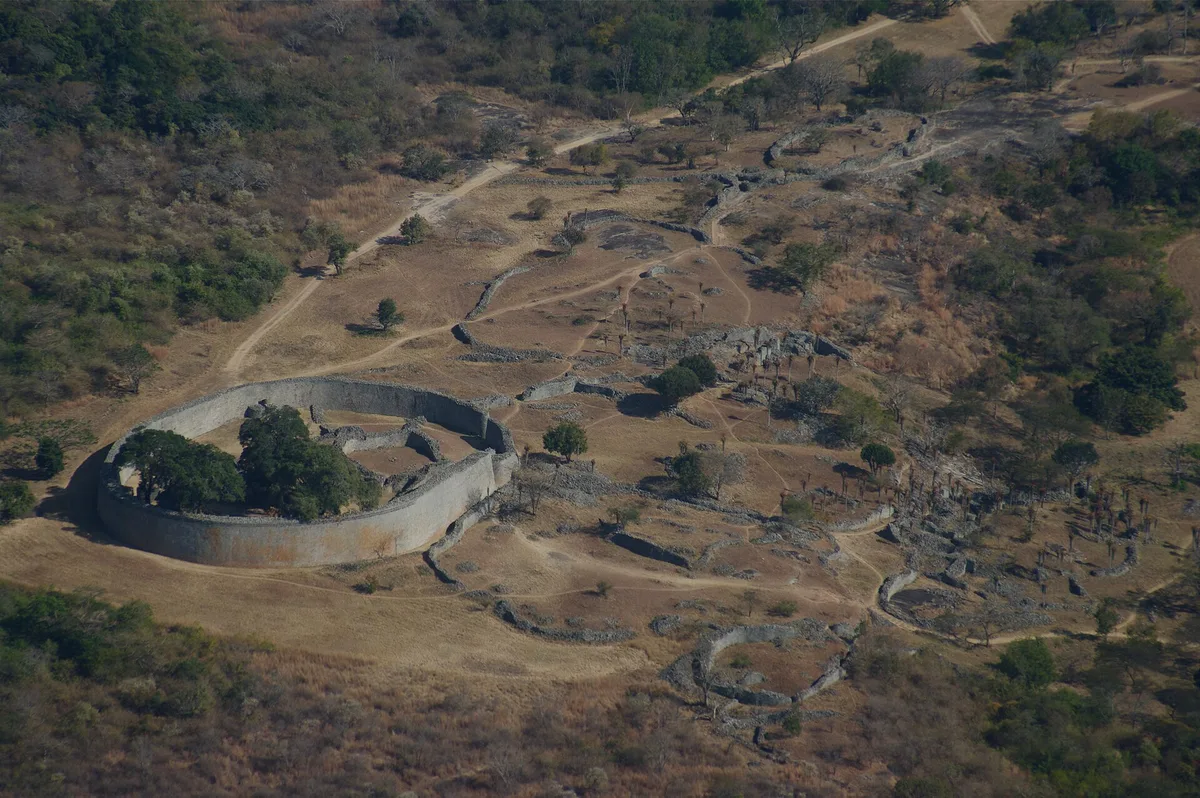
3. Great Zimbabwe (Zimbabwe): a stone city without mortar
Inhabited from around the year 1000, the site became the capital of the Kingdom of Great Zimbabwe starting in the 13th century. Its stone structures were built from the 11th to the 15th century. It is the largest stone structure in Southern Africa before colonization: the city covers 7.22 km². The walls of its Great Enclosure, built without mortar, reach 11m in height and extend for about 250m. Older estimates suggest 18,000 inhabitants at its peak; a recent study suggests the population did not exceed 10,000 people. The site is a UNESCO World Heritage site.
4. Kilwa Kisiwani (Tanzania): "one of the most beautiful cities in the world"
In 1331, the great traveler Ibn Battuta visited Kilwa and described it as one of the most beautiful cities in the world. The city was then wealthy from the gold trade. For about 500 years, from approximately 1100 to 1600, Kilwa minted its own currency; its coins have been found throughout the region, as far as Great Zimbabwe. It preserves the ruins of its Great Mosque, the oldest parts of which date back to the 12th century, and the Husuni Kubwa palace, built in the 14th century. The island has been a UNESCO World Heritage site since 1981.
5. Timbuktu (Mali): a city of scholars
Timbuktu became a permanent city at the beginning of the 12th century. Under the Mali Empire, it attracted merchants and scholars who studied religion, as well as history, law, science, and medicine. The Djingareyber Mosque was built there in 1327 under Mansa Musa, primarily out of earth; it has been a UNESCO World Heritage site since 1988. Around 1300, the city had about 10,000 inhabitants, then nearly 50,000 in the 16th century.
6. Benin City (Nigeria): "larger than Lisbon"
Benin City was the capital of the Kingdom of Benin, which emerged around the 11th century. Starting in 1440, under Oba Ewuare, the kingdom expanded, and around 1460 the city was surrounded by a large moat. In the region, the total of the moats and earth ramparts is estimated at about 16,000 km: Guinness World Records describes them as the longest earthworks of the pre-mechanical era. In 1691, a Portuguese captain wrote that the city was "larger than Lisbon" and that its streets were straight as far as the eye could see. Its artists created the famous Benin Bronzes there.
7. Mbanza Kongo (Angola): the capital of the Kingdom of Kongo
Mbanza Kongo was the capital of the Kingdom of Kongo from its founding, before the arrival of the Portuguese, until 1915. When the Portuguese reached it in 1491, it was already a large city, perhaps the largest in Africa south of the equator; a Portuguese ambassador compared it to the city of Évora. In the 1620s, it reportedly had 30,000 to 45,000 inhabitants. It has been a UNESCO World Heritage site since 2017.
Verdict: FALSE
From Ethiopia to Morocco, from Zimbabwe to Nigeria, Africa built large cities long before colonization: capitals, ports, cities of scholars, described by travelers and today protected by UNESCO.
Our perspective
These cities are rarely cited when talking about the great cities of history. Yet they deserve their place alongside Rome, Paris, or Baghdad. And you, at school, were you told about these cities?
This article was written in French with the help of artificial intelligence from the sources cited below, then translated from French automatically. Read the original.
Sources
- Wikipédia (anglais) : Aksum
- Wikipédia (anglais) : Fez, Morocco
- Wikipédia (anglais) : University of al-Qarawiyyin
- Wikipédia (anglais) : Great Zimbabwe
- Wikipédia (anglais) : Kilwa Kisiwani
- Wikipédia (anglais) : Timbuktu
- Wikipédia (anglais) : Djinguereber Mosque
- Wikipédia (anglais) : Benin City
- Wikipédia (anglais) : Walls of Benin
- Wikipédia (anglais) : M'banza-Kongo