Lalibela, the eleven churches Ethiopia carved into the rock
At an altitude of approximately 2,500 meters, in the mountains of northern Ethiopia, lies one of the most extraordinary places on the continent: eleven medieval churches carved into the rock, still used for prayer today. Here is the story of Lalibela, as told by UNESCO and historians.
A king named by the bees
The city bears the name of the king who made it famous: Gebre Meskel Lalibela, of the Zagwe dynasty, who reigned from approximately 1181 to 1221. According to the account of his life, a swarm of bees surrounded the child at his birth. His mother saw this as a sign of a great destiny and named him Lalibela, which in ancient Agaw is said to mean "the bees recognize his sovereignty." The city, formerly called Roha, later took his name.
A "new Jerusalem"
According to UNESCO, King Lalibela set out to build a "new Jerusalem" when pilgrimages to the Holy Land became impossible. The city's layout mirrors biblical sites: a stream bears the name Jordan, and the churches are divided into two groups on either side of this "river." Local tradition, however, claims that the king carved these churches with the help of angels.
Historians offer a more nuanced view: construction likely took place over several phases, and some specialists, such as archaeologist David Phillipson, believe that some of the structures are older and were transformed later.
Churches carved from top to bottom
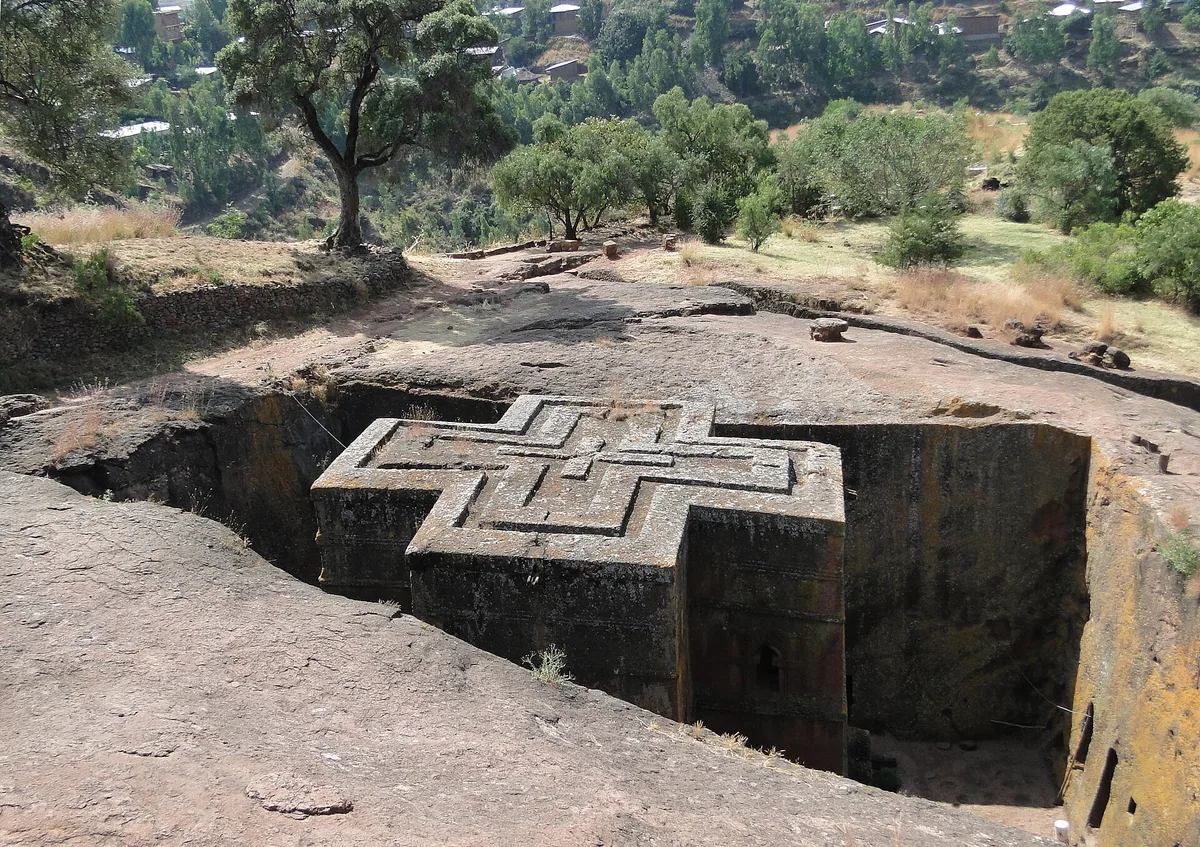
What makes Lalibela unique is the method. The churches were not built stone by stone: they were freed from the rock as monolithic blocks, then hollowed out to carve doors, windows, columns, floors, and roofs. A vast network of ditches, trenches, and processional passages connects everything, sometimes with openings leading to hermit caves, as described by UNESCO.
Biete Medhane Alem, the "House of the Saviour of the World," with its five naves, is considered the largest monolithic church in the world. Biete Ghiorgis, the "House of Saint George," carved from volcanic tuff, forms a cross when viewed from the sky; it is accessed via a narrow, man-made canyon that becomes a tunnel near the church.
"I will be accused of lying"
In the 1520s, the Portuguese priest Francisco Álvares visited Lalibela twice. In his account, he wrote that he would refrain from saying more for fear of being accused of lying, and swore before God that everything he had described was true.
A living place
Lalibela is not a museum. It is, according to UNESCO, a major site of Ethiopian Christianity and has been a place of pilgrimage since the 12th century. During major festivals, such as Genna, the Ethiopian Christmas celebrated on January 7, and Timkat, on January 19, services are accompanied by multi-day processions, music, and rituals. Near the churches, the village preserves two-story round houses made of red stone, the "tukuls" of Lasta.
In 1978, the rock-hewn churches of Lalibela were inscribed as a UNESCO World Heritage site, the year of the very first list.
Our perspective
We often talk about Gothic cathedrals or the temples of Angkor. Lalibela deserves the same place in our minds: a masterpiece of engineering and faith, conceived and realized in Africa eight centuries ago. Knowing these places also means changing the way we look at the history of the continent.
This article was written in French with the help of artificial intelligence from the sources cited below, then translated from French automatically. Read the original.