Matooke, the green banana that means 'food' in Uganda: its history and recipe
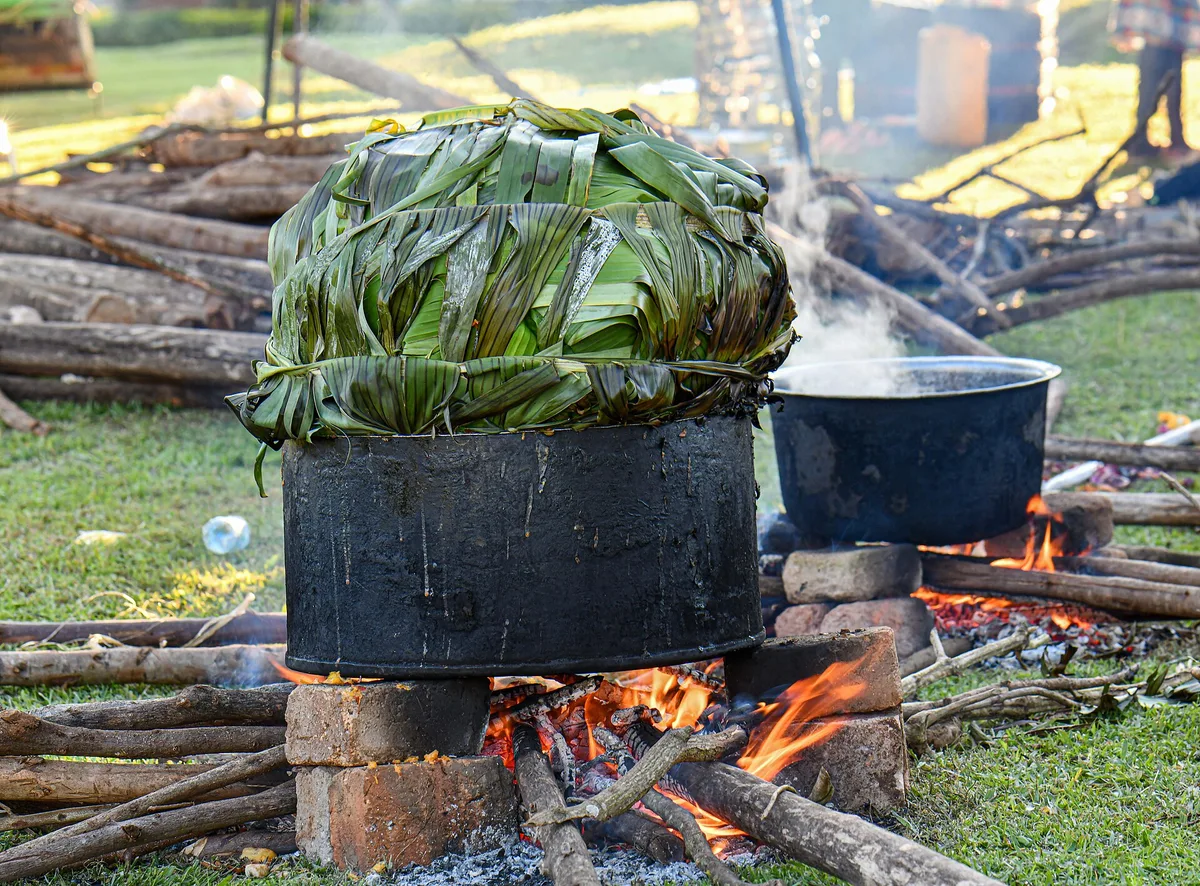
In Buganda, in the heart of Uganda, the green banana, steamed in its own leaves and then mashed by hand, is much more than just a dish. According to the traditional cookbook published by PELUM Uganda and the Daily Monitor newspaper, for the Baganda people, the word emere, meaning 'food', refers to matooke itself. Here is the story of a banana that became an identity.
A banana from the sky, according to legend
The founding myth of Buganda tells the story of Kintu, the first man, and Nambi, the daughter of Ggulu, the god of the sky. As summarized by historian Christopher Wrigley (Kingship and State, Cambridge University Press, 1996), Kintu arrives with the first woman, Nambi, the first cow, and the sprout from which all banana trees were born. In the version collected by Harry Johnston, reported by Wikipedia, Ggulu offers the couple bananas among their wedding gifts, and Kintu and Nambi plant the first crops on earth at Magongo, including the banana.
The accounts vary from one storyteller to another, and they do not hold the value of history. But they do say one thing: for the Baganda, the banana has been there since the beginning of the world.
A banana found nowhere else
Science tells a different story. Matooke bananas, which botanists call 'East African Highland bananas', arrived from Southeast Asia between the 1st and 6th centuries, likely through trade. They then evolved for over a millennium around the African Great Lakes, to the point of forming a distinct group: about 200 varieties, known by more than 500 local names. The International Institute of Tropical Agriculture (IITA) reiterated this in January 2023: they are only found in the highlands of the Great Lakes region.
At the market, vendors call them nandigobe, mussakala, kibuzzi, or nakitembe. 'Only the Baganda could have had the idea of giving names to matooke,' the Daily Monitor jokes.
'Food' means matooke
Without matooke, a meal is not complete. 'Being invited to someone's home in Buganda or western Uganda and being served pasta, rice, or potatoes as a main dish is frankly frowned upon,' writes the Daily Monitor. Matooke is eaten in the morning, at lunch, and at dinner: the newspaper tells of a grandmother who ate the cold leftovers from the previous day, known as gwolu, for breakfast.
The world champion of the banana
According to a study by the International Food Policy Research Institute (IFPRI) published in 2006, a Ugandan eats on average nearly a kilo of bananas per day, the highest consumption in the world. Throughout the Great Lakes region, the IITA estimates the annual consumption of these bananas to be between 250 and 600 kilos per person, and they support 2.5 million farming families.
This wealth remains fragile. Since 2001, banana bacterial wilt has struck Uganda: between 2001 and 2004, it caused harvests to drop by 30 to 52% in the center of the country, according to studies cited by Wikipedia. To cope with this, the IITA and its partners are developing new, more productive hybrid varieties of matooke.
The sauce of kings: luwombo
Matooke is never eaten alone. Its most famous sauce was born at court. In 1887, the New Vision newspaper recounts, Kawuuta, the head chef of the kabaka (the king) of Buganda, served a novel dish: meat wrapped in a smoked banana leaf and steamed, known as luwombo. The leaf serves as both a pot and a plate.
Long reserved for kings, princes, and distinguished visitors, luwombo is now prepared with chicken, beef, fish, or peanuts and mushrooms in every family. Connoisseurs still eat it in its leaf.
The dish for special days
Matooke remains the most important dish for major occasions, PELUM Uganda reminds us, starting with the kwanjula, the ceremony where the groom-to-be and his family are introduced to the bride's family. According to Wikipedia, this ceremony serves as a customary marriage contract in Baganda culture.
It also has its everyday version: katogo, matooke simmered with peanuts, beans, meat, or offal. Originally a dish for the most modest, it has become a breakfast classic, especially in Buganda and the west of the country, the Daily Monitor reports.
The recipe for steamed matooke
This recipe follows the book 'A Cookbook of Uganda's Traditional Foods' (PELUM Uganda, 2019), written by Apollo Kadumukasa Kironde II.
Ingredients for 4 to 6 people: 30 to 40 matooke bananas, ripe but still green; 5 banana leaves; 3 to 5 pieces of banana leaf stalks; water.
1. Peel the bananas with a knife and wash them in clear water. 2. Cut the leaf stalks to the size of the pot and place them at the bottom, about 8 to 10 cm deep. Pour water up to the level of the stalks. 3. Remove the central rib from at least four leaves. Cross two of them, place the bananas on top, wrap them with three leaves, and tie the bundle with banana fibers. 4. Place the bundle on the stalks and cover with the remaining leaves, tightly packed.
5. Cook over medium heat, ideally on a charcoal stove, for 45 minutes to an hour, monitoring the water so it does not evaporate. 6. When the leaves have turned brown, the matooke is ready. Take it out and mash it by hand through a fresh leaf (or a clean, damp cloth so you do not burn yourself) until you get a puree. 7. Wrap the puree back in leaves, put it back in the pot above the water, without contact with it, and let it simmer for at least an hour. 'The longer it takes, the better it is,' the book says.
Serve very hot, ideally in a basket lined with banana leaves (the kibo), with a luwombo, a meat, chicken, fish, or peanut sauce.
For a simple peanut sauce, the same book advises diluting peanut paste in water until you get a smooth, lump-free mixture (500g for 4 to 6 people in its taro leaf version), then letting it simmer for half an hour while stirring from time to time so it does not stick, and adding salt at the end of cooking.
Our perspective
Matooke says something that many of our cuisines know: in Africa, food is never just food. It is memory, hospitality, rank, and pride. A people who call a single dish 'food' are not talking about their stomach; they are talking about their identity. The PELUM Uganda book says it bluntly: the best way to protect our traditional foods is to keep eating them. So this Sunday, the question returns to you: at your table, what do you serve to those you respect?
This article was written in French with the help of artificial intelligence from the sources cited below, then translated from French automatically. Read the original.
Sources
- IITA / CGIAR : Stable and high-yielding farmer-preferred « Matooke » cooking banana hybrids registered (9 janvier 2023)
- IFPRI : Biodiversity of bananas on farms in Uganda (Edmeades, Smale et Karamura, 2006)
- PELUM Uganda : A Cookbook of Uganda's Traditional Foods (A. K. Kironde II, 2019)
- Daily Monitor : Hot tips on how to prepare matooke (2018)
- Daily Monitor : Uganda@50, the king of all Uganda breakfasts (2012)
- New Vision : Oluwombo, epitome of Buganda traditional meal
- Wikipédia (anglais) : Matoke
- Wikipédia (anglais) : Kintu
- Wikipédia (anglais) : Luwombo
- Wikipédia (anglais) : Kwanjula
- Wikipédia (anglais) : Banana Xanthomonas wilt