November 4, 1922: An Egyptian worker finds the step leading to Tutankhamun, history will remember Carter
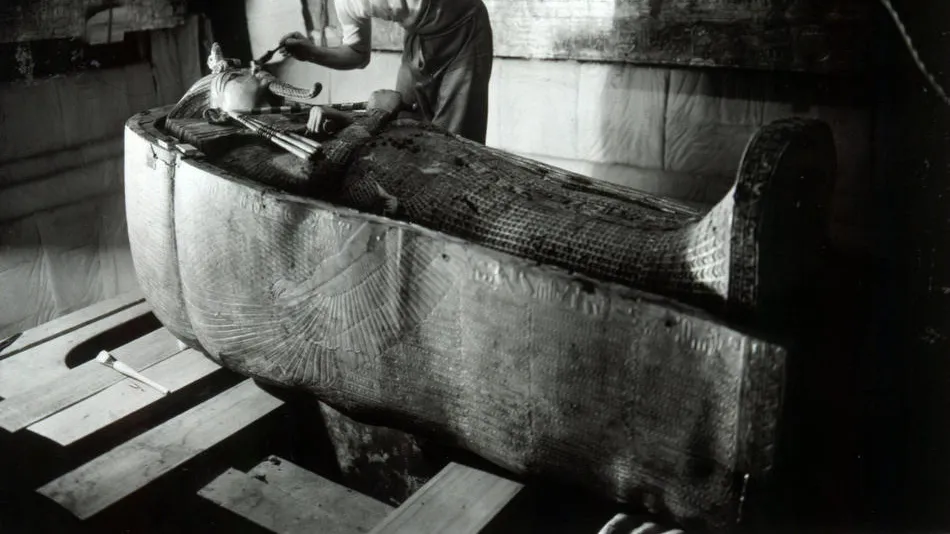
On November 4, 1922, in the Valley of the Kings in Upper Egypt, an Egyptian worker cleared a step carved into the rock, beneath the huts of the builders of the tomb of Ramesses VI. This step led to the tomb of Tutankhamun, the most famous archaeological discovery of the 20th century. His name was never recorded anywhere.
The season had begun three days earlier, according to the World History Encyclopedia. It was the sixth, and in principle the last: the British patron Lord Carnarvon had been funding the excavations of archaeologist Howard Carter without results.
Twelve steps and an intact seal
On the evening of November 5, twelve steps were cleared and the top of a walled door appeared, stamped with the seal of the royal necropolis. Carter had the staircase covered and waited for his patron, who arrived on November 20. On November 23, a nine-meter corridor was cleared; Carter pierced the second door, slipped a candle through, and replied to Carnarvon who asked him: "wonderful things." Wikipedia places the scene on November 26: accounts differ by a few days.
The burial chamber was opened on February 16, 1923, in front of Egyptian officials. More than five thousand objects would be removed from it, and it would take ten years to clear everything.
Fifty workers, four names
Nothing would have been possible without the Egyptian workforce. The Griffith Institute at the University of Oxford, which holds the excavation archives, estimates that Carter relied on about fifty local workers and dozens of children. They were the ones who dismantled the gilded shrines, pierced the wall of the burial chamber, and carried the crates to the barges on the Nile. In his publications, Carter only named and thanked his four foremen: Ahmed Gerigar, Gad Hassan, Hussein Abu Awad, and Hussein Ahmed Said.
The others remained invisible. Their names "were not recorded in the official accounts," writes the Oxford institute, which acknowledges that its own archives offer a "very Eurocentric" view. Egyptian researcher Hend Mohamed Abdel Rahman is now working to restore their identities. Who found the first step remains debated: Carter speaks of his workers, other accounts mention a boy digging outside the assigned area, and recent versions cite the water carrier Hussein Abdel-Rassoul, an attribution that historian Christina Riggs considers confusing.
The treasure that did not leave Egypt
The custom at the time was for finds to be shared equally between Egypt and the foreign patron. Tutankhamun escaped this. In February 1922, London had unilaterally recognized Egypt's independence, and the Antiquities Service now fell under an Egyptian minister. The 1924 agreement ruled out any sharing: the bulk of the funerary furniture remained at the Egyptian Museum in Cairo.
Key takeaways
On November 4, 1922, it was Egyptian hands that touched the first step of Tutankhamun's tomb. Egypt kept the treasure; it is still waiting for history to return their names to those who unearthed it.
This article was written in French with the help of artificial intelligence from the sources cited below, then translated from French automatically. Read the original.