November 7-11, 1989: Namibia finally votes, 97% turnout and 41 out of 72 seats for SWAPO
From November 7 to 11, 1989, Namibians voted for the first time in their history to elect the 72 members of a Constituent Assembly, under the supervision of the United Nations. Out of 701,483 registered voters, 680,788 cast their ballots: a 97.04% turnout, according to the UN Secretary-General's report of November 14, 1989.
On November 14, Special Representative Martti Ahtisaari certified that the election had been free and fair at every stage. Sam Nujoma's SWAPO obtained 384,567 votes, or 57.3% and 41 seats; the Democratic Turnhalle Alliance received 191,532 votes, 28.6% and 21 seats; the United Democratic Front took 5.6% and 4 seats. Five smaller parties shared the final ten seats.
Seventy-four years of occupation, a mandate revoked as early as 1966
This ballot was a long time coming. A German colony of South West Africa from 1884, the territory experienced the repression of the Herero and Nama revolts starting in 1904, which Wikipedia describes as a genocide: between 24,000 and 65,000 Herero were killed, representing 50 to 70% of that people, along with 10,000 Nama, half of their population.
In 1915, South African troops occupied the country; on December 17, 1920, Pretoria received the administration of the territory as a League of Nations Class C mandate. It was the only mandate ever placed under UN trusteeship: Pretoria refused to submit to this in 1946. In October 1966, the General Assembly revoked the mandate; in 1968, it decided the territory would be called Namibia; in 1971, the International Court of Justice ruled the South African presence illegal.
The armed struggle had begun the very year of that revocation: on August 26, 1966, SWAPO fighters launched their first assault at Omugulugwombashe. Resolution 435, adopted in 1978, already provided for a UN plan and the creation of UNTAG. However, eleven years were lost: South Africa accepted the plan in 1980, refused the ceasefire in 1981, and then made independence conditional on the departure of Cuban troops from Angola.
An election under international control, then independence
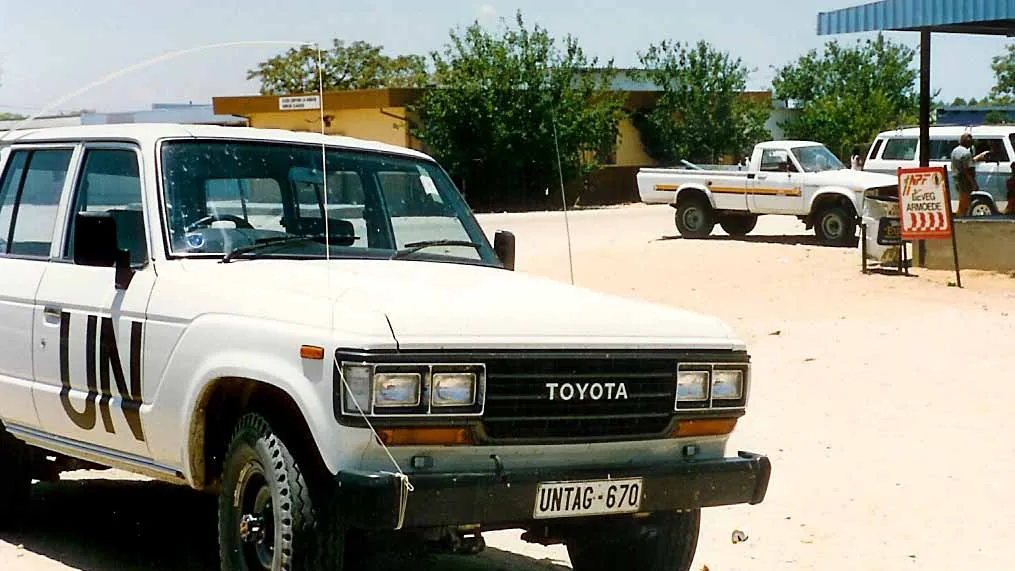
The deadlock was broken on December 22, 1988, with the tripartite agreement signed at UN headquarters by Angola, Cuba, and South Africa, under American mediation. The plan went into effect on April 1, 1989, with a UNTAG force of 4,493 military personnel deployed out of the 7,500 authorized, along with 1,500 police officers and nearly 2,000 civilians, for 358 polling stations, including 143 mobile ones. More than 34,000 Namibian refugees were repatriated.
The Constituent Assembly met on November 21, 1989, and unanimously adopted its Constitution on February 9, 1990. Sam Nujoma was elected president on February 16; independence was proclaimed on March 21, 1990, and Namibia joined the UN on April 23 as the 160th member state.
Key takeaways
In five days in November 1989, a people deprived of the ballot since 1915 elected their Constituent Assembly with a 97% turnout. Namibia was not given its independence: it seized it through armed struggle, international law, and the ballot box.
This article was written in French with the help of artificial intelligence from the sources cited below, then translated from French automatically. Read the original.