Top 10: Africa's natural wonders, from the Sahara to Table Mountain
Deserts, rivers, volcanoes, deltas, stone forests: Africa is home to some of the most spectacular landscapes on the planet. Here are ten natural wonders, from the north to the south of the continent, along with their records and origins.
1. The Sahara: the world's largest hot desert
Covering approximately 9.2 million km², the Sahara is the world's largest hot desert and the third-largest desert on the planet by surface area, after those of Antarctica and the Arctic. It spans a large part of North Africa. Its ergs, such as the Erg Chebbi in Morocco, are seas of sand dunes.
2. The Banc d'Arguin (Mauritania): a haven for birds
On the coast of Mauritania, between Nouakchott and Nouadhibou, the Banc d'Arguin National Park is a World Heritage site. Its immense mudflats host more than two million migratory shorebirds from Northern Europe, Siberia, and Greenland, making it one of the most important sites in the world for these species. Its waters are among the most fish-rich in West Africa. Only a small community, the Imraguen, fishes there using traditional techniques; motorboats are prohibited.
3. Mount Kilimanjaro (Tanzania): the roof of Africa
At 5,895 m at Uhuru Peak, Kilimanjaro is the highest summit in Africa and the highest free-standing mountain in the world. This large dormant volcano is formed by three cones: Kibo, Mawenzi, and Shira. It holds the largest glaciers on the continent.
4. Dallol (Ethiopia): the colors of another planet
In the north of the Afar region, in the Danakil Depression, about 125 m below sea level, lies Dallol. Its hydrothermal springs release water among the most acidic on Earth, with a pH below zero, nearly ten times saltier than seawater, and hotter than 108 °C. The landscape changes in a matter of days, shifting from white to green, yellow, orange, red, and violet: these colors come from the oxidation of iron, not from living organisms. The name Dallol, given by the Afar, means "dissolution." The region is among the hottest and driest places on the planet.
5. The Congo River: the deepest in the world
With measured depths of approximately 220 m, the Congo is the deepest river known in the world. It is the second-longest river in Africa, after the Nile. It flows through the Congo Basin forest, the second-largest tropical forest on the planet.
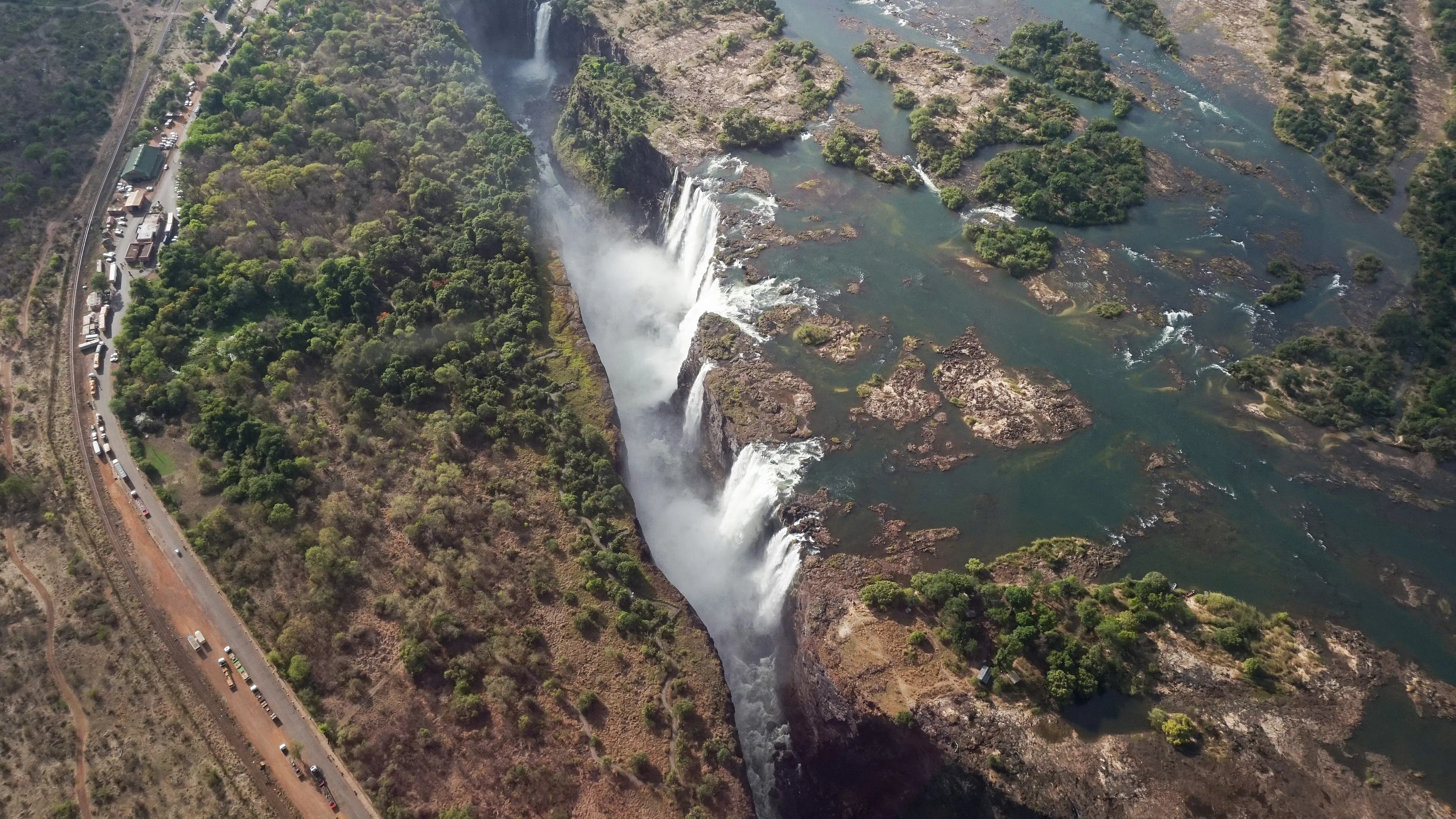
6. Victoria Falls: "the smoke that thunders"
On the Zambezi River, on the border between Zambia and Zimbabwe, Victoria Falls is called Mosi-oa-Tunya in Lozi, meaning "the smoke that thunders." At 1,708 m wide and 108 m high, it forms the largest curtain of falling water in the world.
7. The Okavango Delta (Botswana): the river that never reaches the sea
The Okavango does not flow into the ocean: it spreads out into the Kalahari Basin in an immense inland delta. Its flood arrives in the heart of the dry season, between June and August, and the delta then triples in size, attracting one of the largest concentrations of animals in Africa. On June 22, 2014, it became the 1,000th site inscribed as a UNESCO World Heritage site.
8. The Tsingy de Bemaraha (Madagascar): a stone forest
Near the west coast of Madagascar, the tsingy are limestone needles so sharp that they cut equipment and skin. The word tsingy is said to come from a local word meaning "where one cannot walk barefoot." The reserve has been a UNESCO World Heritage site since 1990, recognized for its unique geography, mangroves, birds, and lemurs.
9. The Namib Desert (Namibia): perhaps the oldest desert in the world
Arid or semi-arid for 55 to 80 million years, the Namib could be the oldest desert in the world. In the Sossusvlei region, several dunes exceed 300 m in height. On the coast, fog from the ocean can envelop the desert for more than 180 days a year.
10. Table Mountain (South Africa): a garden above Cape Town
This flat-topped summit of approximately 1,085 m overlooks the city of Cape Town. It is home to 2,285 species of plants, about 80% of which are fynbos, the typical vegetation of the region. When the wind blows from the southeast, a cloud often spreads over its summit: it is called the "tablecloth."
Our perspective
These wonders remind us that Africa is not just a continent of history and cultures: it is also a natural treasure that must be protected. And you, which one do you dream of seeing one day?
This article was written in French with the help of artificial intelligence from the sources cited below, then translated from French automatically. Read the original.
Sources
- Wikipédia (anglais) : Sahara
- Wikipédia (anglais) : Banc d'Arguin National Park
- Wikipédia (anglais) : Mount Kilimanjaro
- Wikipédia (anglais) : Dallol (hydrothermal system)
- Wikipédia (anglais) : Danakil Depression
- Wikipédia (anglais) : Congo River
- Wikipédia (anglais) : Victoria Falls
- Wikipédia (anglais) : Okavango Delta
- Wikipédia (anglais) : Tsingy de Bemaraha Strict Nature Reserve
- Wikipédia (anglais) : Namib
- Wikipédia (anglais) : Table Mountain