Why was the Sahara green?
Today, the Sahara is one of the largest deserts in the world. However, it has not always been arid. Between approximately 14,500 and 5,500 years ago, a large part of North Africa was covered in vegetation, lakes, and animals. Archaeologists call this period the "African Humid Period."
The starting point is not on Earth, but in the sky. The Earth orbits the Sun along a path that varies slightly, and its axis describes a slow movement called precession. Around 15,000 years ago, this movement caused the Northern Hemisphere's summer to coincide with the time when the Earth is closest to the Sun.
The result: during this period, the Northern Hemisphere's summer received at least 4% more solar energy than it does today. This extra heat strengthened the West African monsoon, the wind system that brings summer rains.
Between approximately 11,000 and 10,000 years ago, the alignment was at its peak: the energy received in summer increased by about 8%. The monsoon then pushed its rains much further north, up to about 23° north latitude, well beyond the current Sahel.
But the monsoon alone is not enough to explain the phenomenon. Climate models show that vegetation acted as an amplifier. Land covered in grass absorbs more of the sun's heat than light-colored sand. It also releases more moisture into the air. Furthermore, a wetter Sahara produces less dust, which in turn limits blocked light and promotes clouds and rain.
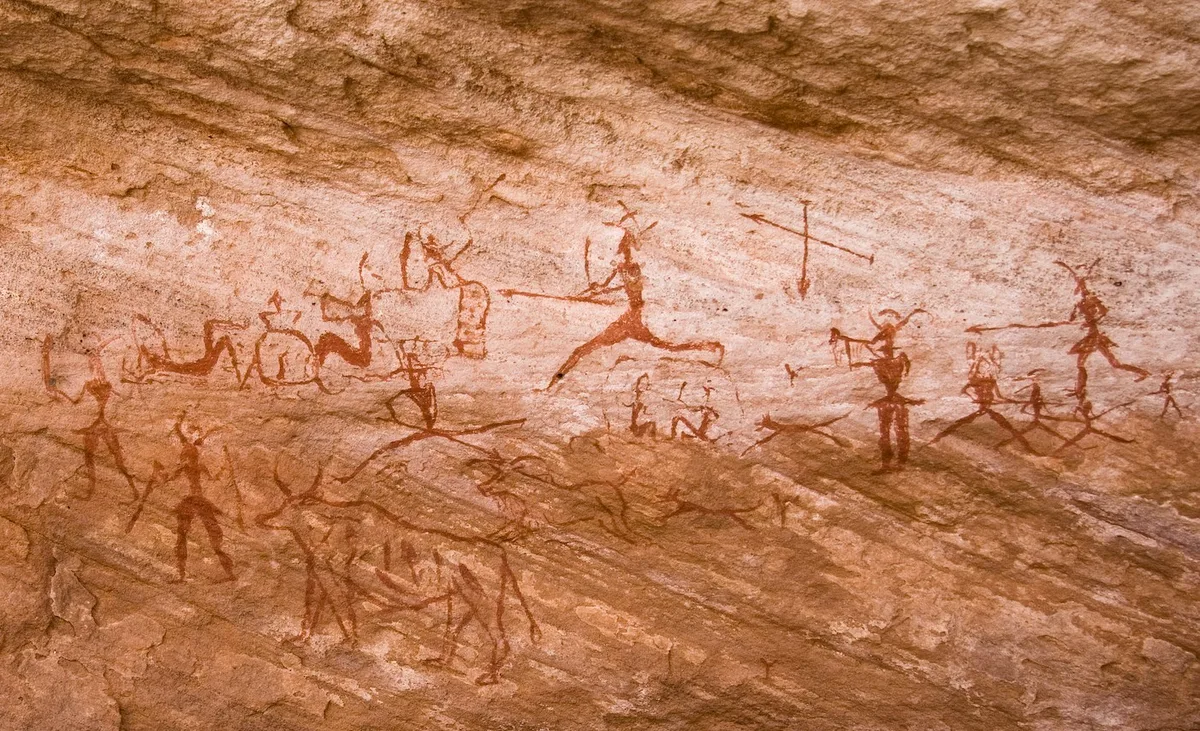
The traces of this era are numerous. Lake Chad, now reduced to a fraction of its former extent, was then at least ten times larger than its current size. Fossils found in the desert testify to a varied fauna: antelopes, giraffes, elephants, crocodiles, and hippopotamuses. Hunter-gatherers lived there, and rock paintings, notably in the Tadrart Acacus in Libya, depict humans and animals.
The end of this period was not abrupt. It happened in stages, between approximately 6,000 and 5,000 years ago depending on the region, with a turning point around 5,500 years ago in the Sahel. Vegetation retreated, rainfall decreased, and the loss of vegetation in turn reinforced the drought. The desert then reclaimed the lands it had left behind.
Why does this past matter today? Because it shows that the desert is not a natural and immutable state. A slow change in the Earth's orbit was enough to transform an entire landscape, and vegetation accelerated the movement. The same feedback mechanisms are being studied today to understand future climates.
Researchers do not all agree on the relative importance of each factor. A study published in 2022 in the journal Climate of the Past shows that the Earth's orbit is the dominant factor in the greening of the Sahara, but that greenhouse gas concentrations and ice sheets also play a role, particularly regarding temperature.
So, what tipped the Sahara the most? The Earth's orbit, the disappearance of vegetation, or human activity? Share your opinion in the comments. The answer is not obvious, and that is precisely what makes the question interesting.
This article was written in French with the help of artificial intelligence from the sources cited below, then translated from French automatically. Read the original.