"Africa had no writing": false, here are eight African scripts that prove it
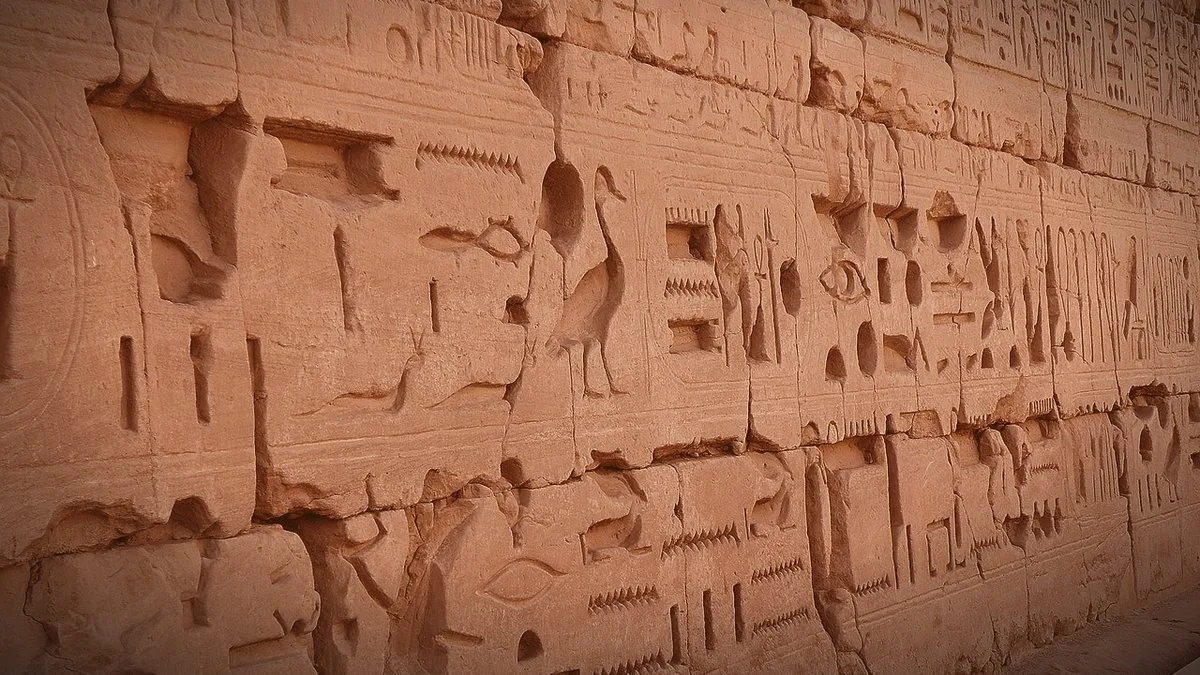
For centuries, it has been repeated that Africa had no writing before the arrival of Europeans, and that its history was purely oral. This idea circulated in books for a long time, and it still survives in many minds. Yet, it is false. From the banks of the Nile to the Sahara, from Aksum to Timbuktu and as far as Cameroon, Africa has invented, adapted, and transmitted writing systems for over 5,000 years. Here are eight of them, with evidence to support it.
1. Hieroglyphs, ancestors of our alphabet
Egyptian hieroglyphs appeared around 3200 BCE. They are among the oldest known writing systems, and historians classify them as one of the rare writing systems born without outside influence. They combine idea-signs, word-signs, and sound-signs, with more than a thousand characters.
Their legacy is immense. According to specialists cited by Wikipedia, a script derived from hieroglyphs, Proto-Sinaitic, gave rise to the Phoenician alphabet. This led to the Greek alphabet, then the Latin alphabet, and Aramaic, the ancestor of the Arabic alphabet. In other words, the letters you are reading right now have African roots.
2. Meroitic, the mystery of Kush
Further south, in present-day Sudan, the Kingdom of Kush developed its own writing in the 3rd century BCE: Meroitic, in two forms, one inspired by hieroglyphs, the other cursive. The last known inscription dates back to the 5th century CE.
In 1909, British Egyptologist Francis Llewellyn Griffith succeeded in reading its signs aloud. But more than a century later, the Meroitic language itself remains largely misunderstood: we know how to pronounce the words, without always knowing what they mean.
3. Ge'ez, a living script since Aksum
In the Horn of Africa, inscriptions in South Arabian script appeared in Eritrea as early as the 9th century BCE. They evolved into the Ge'ez script, which began noting vowels in the 4th century, under King Ezana of Aksum.
This script has never ceased to be used. Ge'ez remains the liturgical language of the Orthodox Churches of Ethiopia and Eritrea, and its alphabet is used today to write Amharic, Tigrinya, and about twenty other languages. Millions of people use it every day.
4. Timbuktu, the city of manuscripts
In Timbuktu, Mali, generations of scholars wrote and copied manuscripts on art, medicine, philosophy, science, and religion. The oldest date back to the end of the 13th century, the most recent to the beginning of the 20th. Their exact number remains unknown, as many have never been cataloged.
In 2012 and 2013, when jihadist groups occupied the city, about 350,000 manuscripts were moved to safety, largely to Bamako, where 300,000 were still located in 2022. More than 4,000 were burned or stolen during those months.
5. Tifinagh, the alphabet of the desert
In North Africa, Berber peoples wrote with the Libyco-Berber alphabet during the first millennium BCE, as evidenced by the inscriptions of Dougga, in Tunisia. Its heir, Tifinagh, is still used by the Tuareg of the Sahara, from southern Algeria to northern Mali and Niger. A modernized version, Neo-Tifinagh, was created in the 1970s.
6. King Njoya's script, in Cameroon
In 1896, Ibrahim Njoya, King of the Bamum in western Cameroon, created a script for his language. He evolved it through six versions: starting from a system of 500 to 600 drawings, it became a syllabary of 80 signs in 1910. In 1918, he even had copper characters cast to print it.
The Bamum script fell into disuse in 1931, with Njoya's exile to Yaoundé. Since about 2007, a project based in Foumban, the former capital of the kingdom, has been working to revive it.
7. Vai, born in Liberia in the 1830s
In Liberia, Momolu Duwalu Bukele created a syllabary for the Vai language, documented as early as the 1830s. It is today one of the two scripts invented in West Africa that has the most users and texts.
8. N'ko, the response of Solomana Kanté
The other is N'ko. In 1949, Guinean Solomana Kanté invented this alphabet for the Manding languages, spoken by millions of people in West Africa. According to the story told by his supporters, he wanted to respond to an author who compared African languages to the singing of birds, "impossible to transcribe." On his tomb, a plaque recalls that he was the inventor of the N'ko alphabet.
Our perspective
The idea of an Africa without writing has never stood up to the facts. It primarily served to present a continent without history, to which everything had to be taught. Hieroglyphs, the Timbuktu manuscripts, or King Njoya's script tell the opposite: peoples who recorded their knowledge, their prayers, and their laws. Knowing them is to rectify an injustice. Teaching them is perhaps the best way to rectify it for good.
This article was written in French with the help of artificial intelligence from the sources cited below, then translated from French automatically. Read the original.
Sources
- Wikipédia (anglais) : Egyptian hieroglyphs
- Wikipédia (anglais) : Meroitic script
- Wikipédia (anglais) : Geʽez script
- Wikipédia (anglais) : Timbuktu manuscripts
- Wikipédia (anglais) : Libyco-Berber alphabet
- Wikipédia (anglais) : Tifinagh
- Wikipédia (anglais) : Bamum script
- Wikipédia (anglais) : Vai syllabary
- Wikipédia (anglais) : N'Ko script